

200-Hour Salt Spray Test for Chrome Plated Rods
What It Proves and What It Doesn’t
Chrome plated rods are widely used in hydraulic cylinders, lifting equipment, agricultural machinery, and automation linear systems. Engineers and buyers often reference a 200-hour neutral salt spray (NSS) test result as proof of corrosion resistance. While this benchmark has become a common acceptance criterion in industrial sourcing, it is frequently misunderstood. A 200-hour pass is valuable quality evidence — but it is not a guarantee of unlimited service life in real working conditions. This article clarifies what the test demonstrates, its inherent limitations, and how to interpret the report correctly for engineering procurement.
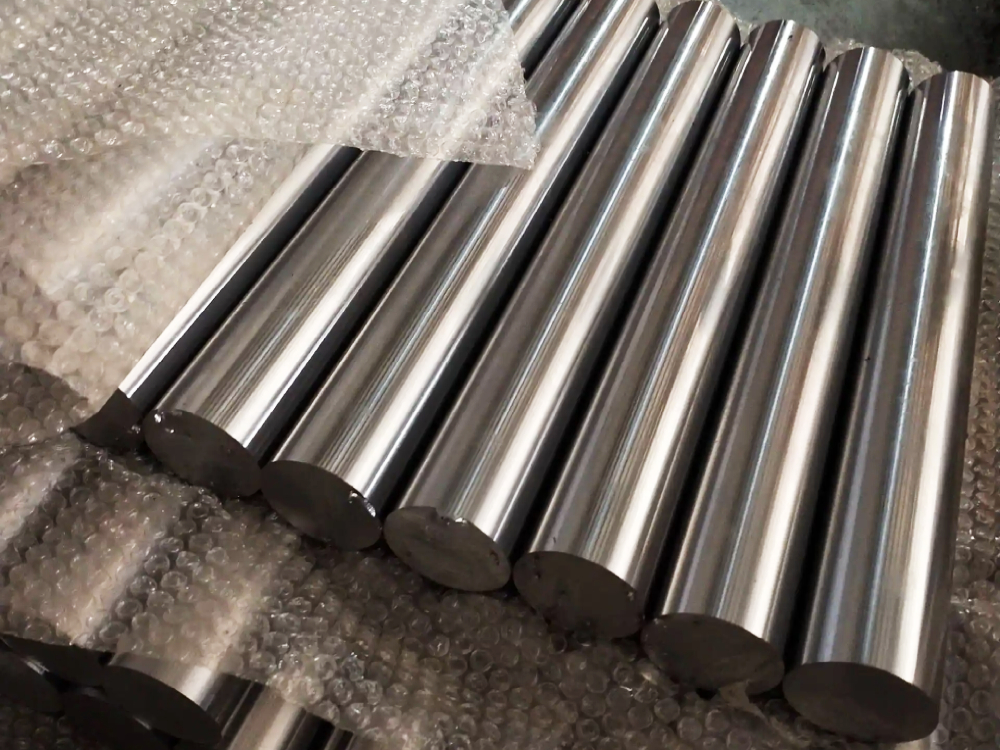
What a 200-Hour Salt Spray Test Proves
First, the standard test environment follows ASTM B117 or ISO 9227 neutral salt spray: continuous fog of 5% sodium chloride solution, temperature stabilized at 35°C, pH controlled between 6.5–7.2, with specimens mounted at 15–30 degrees for uniform fog coverage. When a chrome plated rod completes 200 hours without red rust, heavy blistering or widespread undercoating corrosion, it confirms several practical points.
It proves the plating system has consistent barrier quality. Hard chrome plating itself is naturally porous at the micro level. A successful 200-hour result indicates the manufacturer has controlled key variables: proper substrate pre-treatment, adequate underlayer (usually nickel or intermediate layers), sufficient chrome thickness, low porosity, good adhesion, and minimized micro-cracks on the rod surface. Rods that fail early in salt spray almost always show defects such as pinholes, poor cleaning before plating, uneven coating thickness, or peeling edges. This test is an effective screening tool to separate poorly finished batches from stable ones.
It delivers a repeatable benchmark for side-by-side comparison. For suppliers and buyers, 200 hours creates a common quality baseline. If two chrome rod samples are tested under identical NSS conditions, the one passing 200 hours clearly outperforms another that fails at 72 or 96 hours. This makes the test useful for vendor qualification, batch release inspection, and process validation after plating line adjustments. It is a relative performance metric, ideal for internal quality control and tender specification checks.
It also suggests suitability for mild-to-moderate corrosive environments. A 200-hour NSS pass typically means the rod can tolerate indoor factory humidity, occasional rain splash, fresh water washdown, and light airborne salt exposure inland or far from coastlines. For many standard hydraulic applications away from marine or chemical zones, this level is enough to reduce the risk of surface rust before assembly and during storage and transit.
What a 200-Hour Salt Spray Test Does NOT Prove
This is the section where misinterpretation creates costly field failures. Most critically, 200 salt spray hours cannot be converted directly into real-world service years. There is no fixed mathematical conversion factor between chamber hours and outdoor service life. The salt fog chamber maintains constant, continuous salt attack; natural exposure includes wet-dry cycles, UV radiation, temperature swings, condensation, abrasion, chemical contaminants, and periods of complete drying. A rod passing 200 hours in the lab may rust quickly on an offshore platform, while another rod with the same test rating can last for years in a dry inland workshop.
It does not prove performance after mechanical wear and damage. Chrome plated rods in service constantly slide against seals, bearings, and guide sleeves. Scratches, impact marks, nicks, and wear grooves break the continuous chrome barrier. Once the coating is scratched deep enough to reach the steel substrate, galvanic corrosion starts rapidly underneath the chrome layer. The salt spray test uses carefully handled, undamaged test samples. It tells you nothing about corrosion resistance after abrasion, impact, or seal friction — the very damage modes that end most hydraulic rod service life.
It does not represent all corrosive chemistries. Neutral salt spray only simulates sodium chloride fog. It does not replicate acid rain, fertilizer chemicals, industrial sulphur compounds, de-icing fluids, alkaline cleaning agents, or hydrogen sulphide. A chrome rod rated 200 hours NSS may perform poorly in farm environments with manure and fertilisers, chemical plants, or road machinery exposed to calcium chloride de-icers. For those applications, CASS, cyclic corrosion testing or field exposure trials are far more relevant.
It does not verify mechanical properties. Salt spray inspection focuses purely on corrosion appearance. It does not measure surface roughness, microhardness, wear resistance, coefficient of friction, straightness, dimensional tolerance, or fatigue strength. A rod can pass 200 hours salt spray perfectly yet still fail in service due to insufficient chrome hardness, poor surface finish that leaks hydraulic oil, or plating-induced residual stress that causes cracking under cyclic load. Corrosion performance and mechanical performance are separate validation targets.
It also does not guarantee consistent results across every piece in a batch. A test report is based on selected sample rods. Plating is sensitive to racking position, current density, surface preparation variation, and bath ageing. Sample success reduces risk but cannot eliminate occasional outliers. Critical high-risk equipment should include additional sampling, thickness checks, and adhesion tests alongside salt spray certification.
How to Use the 200-Hour Salt Spray Result Wisely
Treat the 200-hour NSS rating as a minimum quality gate rather than a lifetime warranty. When writing specifications, always attach the full test standard: specify ASTM B117 or ISO 9227, NSS method, acceptance criteria (no red rust, limited white corrosion, no blistering), sample selection rules, and post-test evaluation standard such as ISO 10289. A report simply marked “200h salt spray passed” without these details has limited value.
Match the requirement to your operating environment. For inland, sheltered hydraulic cylinders, 200 hours NSS is reasonable. For coastal, marine, chemical, or road service, raise the requirement, add cyclic corrosion testing, or consider alternative coatings such as SRB skived roller burnished tubes, special alloy overlays or duplex surface treatments.
Combine salt spray with complementary tests. Require coating thickness measurement, cross-hatch adhesion test, surface roughness report, hardness test, and dimensional inspection. For high-value projects, run separate abrasion-plus-corrosion tests to simulate seal wear before salt exposure.
Conclusion
A 200-hour neutral salt spray pass is a meaningful checkpoint for chrome plated rods. It demonstrates that the plating process is well-controlled, porosity is low, adhesion is acceptable, and the coating offers solid barrier protection for moderate exposure. But it is only one piece of the qualification puzzle. It cannot predict real-world lifespan, resist abrasion, survive aggressive industrial chemicals, or validate mechanical performance.
Smart buyers and design engineers use this test to filter unreliable suppliers and stabilise production quality — while avoiding the common mistake of treating “200 hours salt spray” as a promise that the rod will never rust in the field. Corrosion is complex; the chamber is simple.


