

Honed Tube: Precision Bore Tubing for Hydraulic and Pneumatic Cylinders
A honed tube, also widely called hydraulic cylinder tube, is a precision seamless steel tubing specially finished on the inner bore by honing or skiving and roller burnishing. It is the core blank for manufacturing hydraulic and pneumatic cylinder barrels, designed to meet strict requirements for dimensional accuracy, roundness, straightness and low-friction inner surface finish.
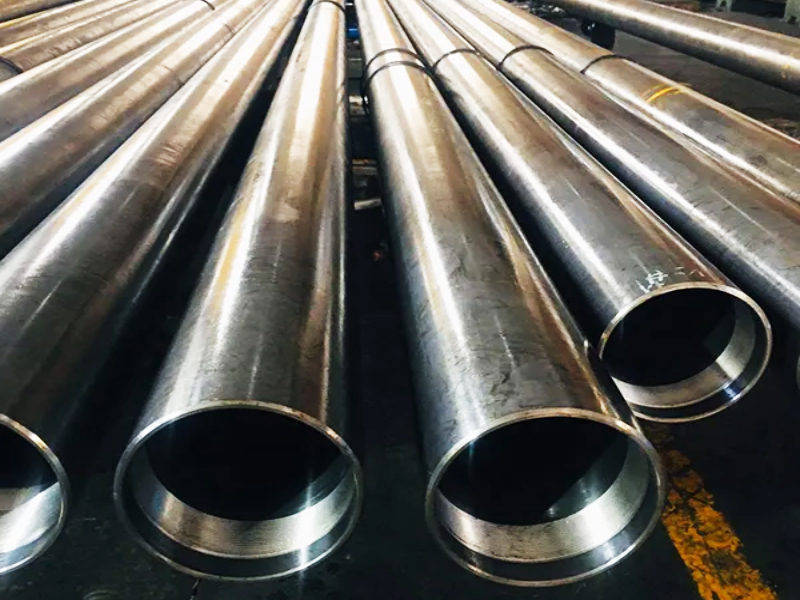
Ordinary seamless steel pipes only guarantee basic outer and inner sizes. After cold drawing, the inner wall still has tool marks, ovality and uneven surface texture. The honing process changes this completely. A honing head fitted with abrasive stones rotates and reciprocates inside the tube at the same time, removing tiny material layers, correcting geometric errors and generating a uniform cross‑hatched surface pattern. This special cross‑hatch texture is not for decoration: it can hold a thin oil film between piston seals and the tube wall, supporting continuous lubrication while preventing oil leakage under high pressure.
High‑quality honed tubes normally reach surface roughness Ra 0.2–0.4 μm, with inner diameter tolerance controlled to H7, H8 or H9 grade. Straightness is kept below 0.5 mm per meter, and roundness error is tightly restricted. Common material grades include E355 (ST52), SAE1020, SAE1026, 4140 alloy steel and stainless steel for corrosion‑demanding working conditions. Main production standards cover EN 10305‑1, ASTM A519 and GB/T 8713. Many suppliers offer custom cut‑to‑length service, with ID ranging from 20 mm up to over 1000 mm and single length available up to 16 meters.
The advantages of honed tubing directly solve common pain points in fluid power systems. First, friction between seals and bore surface is greatly reduced, which lowers heat generation and improves cylinder efficiency. Second, the stable, smooth bore slows down seal abrasion, extending seal service life and cutting downtime and replacement cost. Third, excellent geometric precision ensures steady, jitter‑free linear movement of pistons, even under cyclic heavy loads. Compared with unfinished seamless tubes, honed tubes arrive ready for cylinder assembly without secondary internal machining, saving production time for cylinder manufacturers.
Honed tubes are used across nearly all heavy‑duty and mobile machinery sectors. Construction machinery such as excavators, loaders and cranes relies heavily on honed tubes for lifting, tilting and steering cylinders. Agricultural equipment including tractors, harvesters and planters uses them for hydraulic control of working attachments. Material handling equipment like forklifts, scissor lifts and aerial work platforms depends on honed tubing for safe lifting functions. Other typical fields cover marine deck machinery, offshore drilling equipment, mining machinery, injection molding machines, and automated factory pneumatic systems. Stainless steel honed tubes are selected for wet, saltwater or chemical environments where rust must be avoided.
When selecting honed tubes, buyers should match specifications with working pressure, stroke length, medium and ambient environment. For high‑pressure, heavy‑cycle hydraulic cylinders, E355 or alloy steel with tighter Ra and H7 tolerance is preferred. For low‑pressure pneumatic cylinders, a looser H9 tolerance and higher Ra can control cost reasonably. Surface protection, end machining, threading and anti‑rust packaging are also configurable according to OEM drawings.
As a foundational precision component in fluid power transmission, honed tubes are often overlooked but decisive for cylinder performance. A poorly honed bore leads to early seal failure, internal leakage, slow response and high failure rates. Reliable honed tube supply directly helps cylinder manufacturers deliver stable, long‑lasting hydraulic products to global markets. With the growth of automation, new energy machinery and large mining equipment, demand for high‑precision, high‑pressure honed tubing keeps rising, making it an irreplaceable part of modern hydraulic engineering.
FAQ
Q: What is the difference between honed tube and skived & roller burnished tube?A: Both are cylinder tubes. Honing uses abrasive stones; skiving plus roller burnishing cuts the bore then cold‑rolls the surface. Burnished tubes usually have better compressive stress and wear resistance for ultra‑high pressure service.
Q: Can honed tubes be used without plating?A: Yes. Carbon steel honed tubes work well for standard hydraulic oil circuits. For corrosion resistance, stainless steel or inner chrome plating is required.
Q: What is the typical MOQ for custom honed tubes?A: Most manufacturers support small batch and OEM orders. Stock standard sizes have no strict MOQ, while special ID, OD and long lengths usually require a minimum production quantity.


