

Honed Tube vs SRB Tube vs Cold-Drawn Tube
Which Bore Finish for Your Cylinder?
Hydraulic and pneumatic cylinder performance lives or dies by the internal bore finish. Seal service life, friction, leakage, pressure holding capacity, and overall cylinder reliability all depend on how the barrel’s inner surface is finished. Three options dominate the market: honed tube, SRB (Skived and Roller Burnished) tube, and cold-drawn tube. Each follows a different manufacturing path, delivers a distinct surface texture, and fits a specific range of cylinder applications. Choosing the wrong bore finish leads to premature seal wear, higher downtime, and inflated operating costs. This guide breaks down their processes, technical characteristics, pros and cons, and best-use cases to help you select the right barrel for your cylinder design.
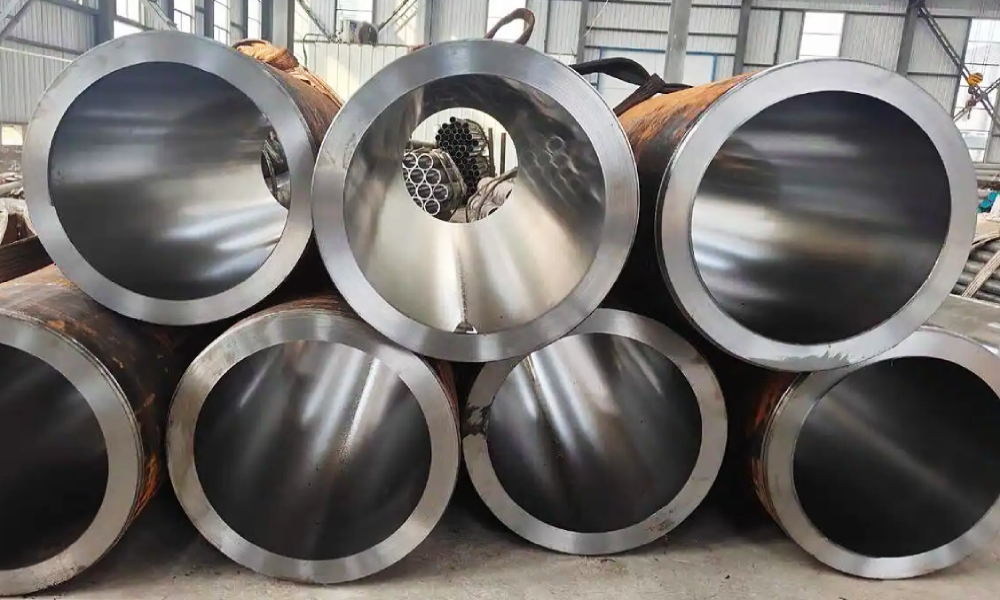
Cold-Drawn Tube: The Base Precision Blank
Cold-drawn seamless tube, often abbreviated as CDS, is the raw starting point for most honed and SRB cylinders. It is produced by pulling hot-rolled seamless pipe through a die and mandrel at room temperature. Cold drawing improves dimensional consistency, roundness, and tensile strength compared to hot-rolled tubing, but it is not a final bore finish for most working hydraulic cylinders.
Typical internal roughness for as-drawn cold-drawn tube runs Ra 1.0–2.0 μm, with ID tolerance commonly at ISO H10 or H11. There is no controlled cross-hatch or plateau burnished texture. For simple low-pressure pneumatic cylinders, low-duty actuation, or non-critical structural sleeves, cold-drawn tube can work directly. But for hydraulic systems with dynamic piston seals, the surface peaks and inconsistent texture quickly abrade seals and cause steady fluid leakage.
Its biggest advantage is cost. Cold-drawn tube is the most economical barrel option when high precision and long seal life are not required. It is also widely stocked and available across standard OD and wall sizes, commonly in grades such as ST52/E355, SAE 1026, and CK45. Most manufacturers supply cold-drawn tube as a blank for secondary finishing: honing or SRB processing.
Best for: Low-pressure pneumatic cylinders, static sleeves, prototype blanks, low-cycle light-duty actuators, and cost-sensitive non-sealing applications.Avoid for: High-pressure hydraulics, continuous cycling, heavy load, and long seal-life requirements.
Honed Tube: The Traditional Cross-Hatch Standard
Honing is the classic bore finishing process for hydraulic cylinders. A rotating, reciprocating honing head fitted with abrasive stones machines the internal surface, removing a thin layer of material and cutting a uniform cross-hatch pattern into the bore. The intersecting grooves, usually at a 30–60° angle, act as tiny oil reservoirs that retain a continuous hydrodynamic lubrication film between the bore and piston seal during movement.
Standard honed tube achieves Ra 0.2–0.8 μm and ID tolerances from H8 down to H7 for premium runs. The cross-hatch texture is its defining feature. Even when the arithmetic roughness value looks similar to SRB, the functional behaviour differs: honing is engineered for lubricant retention. This makes honed bore surfaces very forgiving under marginal lubrication, intermittent cycling, and side-loaded piston conditions. Honing also does an excellent job correcting geometry errors, including ovality, taper, and straightness issues inherited from the raw cold-drawn blank.
The trade-off is speed. Honing is a slower, multi-pass operation. Abrasive sludge must be fully flushed after processing; leftover honing grit is a major failure risk for seals and hydraulic valves. For low to medium batch sizes, custom bore diameters, rework jobs, or repair cylinders, honing remains a reliable and flexible choice. Many seal manufacturers originally designed their packing sets around the cross-hatch honed profile.
Best for: Custom cylinders, repair and re-boring work, side-loaded cylinders, equipment with marginal oil filtration, low-to-medium production volumes, and systems where consistent oil film retention is critical. It is widely used in construction, agricultural, and general industrial hydraulics.Limitations: Slower cycle time for mass production, risk of abrasive contamination if cleaning is incomplete, higher unit cost in high-volume runs.
SRB (Skived and Roller Burnished) Tube: High-Volume Plateau Finish
SRB stands for Skived and Roller Burnished, a single-pass, high-speed finishing process that has grown rapidly in modern cylinder manufacturing. First, a skiving cutter trims a controlled thin layer from the bore to remove drawing marks and correct diameter. Immediately behind the cutter, hardened rollers compress and cold-work the surface, plastically deforming peaks into a dense, plateau-style finish rather than cutting abrasive grooves.
SRB commonly delivers Ra 0.2–0.4 μm, often smoother than standard honing, with tight H7–H8 ID tolerances. The roller burnishing operation introduces compressive residual stress into the subsurface layer, raising surface hardness and fatigue resistance. This improves resistance to crack propagation under repeated pressure spikes, a key benefit for high-pressure heavy-duty cylindersMade-in-Ch....
The major commercial advantage is throughput. SRB runs many times faster than honing, making it the dominant choice for high-volume cylinder factories. It produces no abrasive grit or slurry, simplifying cleaning and reducing contamination risk. The downside is the absence of the honing cross-hatch oil pockets. SRB’s smooth plateau surface relies on uniform, clean hydraulic oil to maintain lubrication. Poor filtration or oil starvation can accelerate seal wear compared to a properly honed bore. SRB is also less effective at fixing severe geometry defects in poorly straightened raw tube; the blank quality matters more upfront than it does for honing.
Best for: Mass-produced hydraulic cylinders, mobile machinery, high-pressure circuits, well-filtered hydraulic systems, welded tube barrels, and applications prioritising fast lead times and consistent surface repeatability.Limitations: Less forgiving of poor lubrication or contaminated oil, limited ability to correct heavy ovality/taper, not ideal for re-boring and repair work.
Side-by-Side Selection Guide
| Feature | Cold-Drawn Tube | Honed Tube | SRB Tube |
|---|---|---|---|
| Typical Ra | 1.0–2.0 μm | 0.2–0.8 μm | 0.2–0.4 μm |
| Standard Tolerance | H10 / H11 | H8 / H7 | H7 / H8 |
| Surface Texture | Raw drawn texture | Cross-hatch oil-retention pattern | Smooth plateau, no cross-hatch |
| Residual Stress | Neutral | Minimal material removal stress | Compressive, work-hardened surface |
| Production Speed | Fast (as-drawn) | Slow, multi-pass | Very fast, single-pass |
| Contamination Risk | Low (unfinished) | High if poorly flushed | Low, no abrasive grit |
| Seal Lubrication | Poor for dynamic seals | Excellent oil retention | Good with clean, well-filtered oil |
| Geometry Correction | None | Strong | Moderate, depends on blank quality |
| Typical Cost | Lowest | Medium | Medium-low at high volume |
How to Make the Final Choice
Start with your operating pressure and cycle duty. For low-pressure, slow-cycle pneumatic actuators and non-dynamic sleeves, cold-drawn tube is sufficient and budget-friendly. For most custom, repaired, or side-loaded hydraulic cylinders, honed tube remains the safer default, thanks to its cross-hatch oil pockets and robust geometry correction.
If you are manufacturing large batches of mobile or industrial hydraulic cylinders with clean, maintained hydraulic circuits, SRB tube usually delivers better consistency, faster lead times, and improved fatigue performance. Always cross-check your seal supplier’s specification: some polyurethane and PTFE seal grades are optimised specifically for plateau SRB surfaces, while older nitrile seal designs often perform better on traditional honed cross-hatch bores.
Material grade, tube length, bore diameter, and whether the barrel is seamless or welded also influence the decision. Welded tubes are frequently finished with SRB, while tricky re-bore repair work is almost always completed by honing.
Final Takeaway
There is no universal “best” bore finish for every cylinder. Cold-drawn tube is an economical blank, honed tube is the lubrication-friendly workhorse built around the proven cross-hatch pattern, and SRB tube is the high-speed, fatigue-resistant plateau finish for modern mass-produced hydraulics. Matching the bore finish to your pressure, cycle rate, filtration quality, seal type, and production volume will extend seal life, cut leakage, and reduce cylinder service costs over the product’s whole lifecycle.


